
User Roles
UnSpot has seven assignable roles: Member, Office manager, Offices Administrator, Users Administrator, Integrations Administrator, Reception, and Super Administrator. Each role has its own level of access. Every invited user starts as a Member until an administrator changes the role or grants assignments.
The role is set in the employee profile: Manage → People management → Users → Edit, the Role section. Roles are assigned by the Super Administrator.
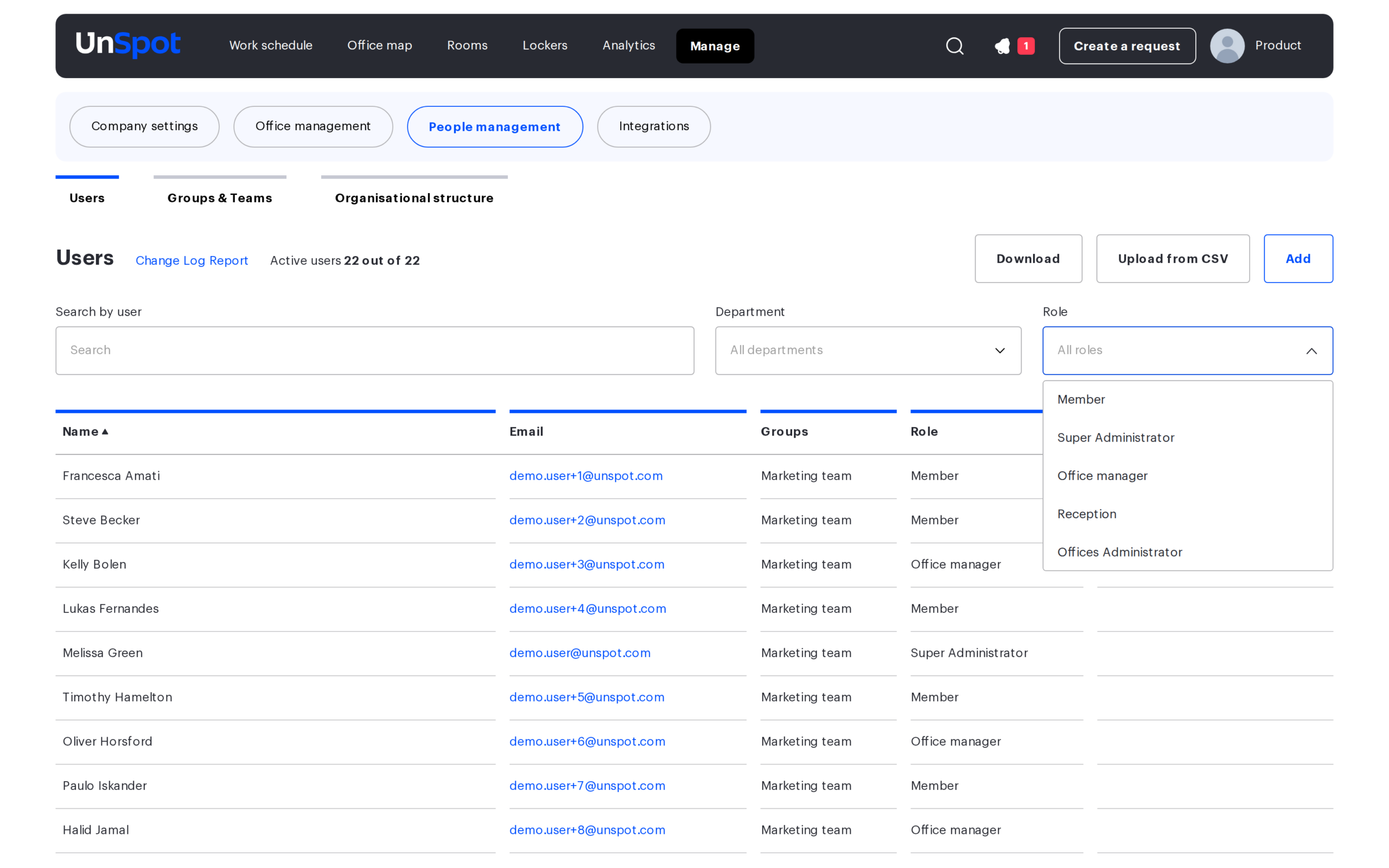
Roles and what they can do
| Role | What it can do |
|---|---|
| Member | The default role: book desks, meeting rooms, and parking; manage their own schedule and profile; use the office map. |
| Office manager | Everything a Member can, plus Analytics (including administrative reports and logs), editing floor maps and existing office cards (opened from the Office map), and booking past restrictive booking policies. Creating offices and the console tabs are not available. When the Visitors module is enabled, the Office manager sees visitor pass requests from all users and can complete (“Pass ordered”) or decline any request. Can have subordinates; reports are limited to their subordinates. |
| Offices Administrator | The Company settings and Office management tabs and Analytics. |
| Users Administrator | The People management tab: adding and editing employees, booking and schedules for all employees, logging in as another user (Members only) and sending them credentials. Cannot change roles — the role selector is not available to this role. |
| Integrations Administrator | The Integrations tab: synchronisations, login options / SSO, incoming and outgoing webhooks, meeting room displays, API settings. |
| Reception | The reception pages only: visitors and vehicle passes (parking reception). |
| Super Administrator | Full access to everything, including sections available to no other role: Groups & Teams (resource access groups), Access requests in the Inbox, and assigning roles to all users. |
Assignments that are not roles
Some management capabilities are granted to a regular Member as assignments in the employee profile, without changing the role:
- Subordinates (“None” / “Custom users” / “All users”) — the employee becomes a manager: sees the schedule and bookings of their subordinates and their reports in Analytics.
- Teams — managing the schedule and bookings of selected teams.
- Department manager — assigned in People management → Organisational structure; grants manager capabilities over the department.
- Meeting room coordinator — the employee approves booking requests for selected meeting rooms (the Delegate badge; requests arrive in the Inbox).
Permissions matrix
Legend: ✓ — available by default, ⚙ — configurable (off by default; enabled via a setting or an assignment), — — not available. Manager is not a separate role but an assignment in the employee profile (“Subordinates”, “Teams”) or department management in the Organisational structure; assignments combine with any role.
Booking
| Capability | Member | Manager | Office manager | Offices Admin | Users Admin | Integrations Admin | Super Admin | Reception |
|---|---|---|---|---|---|---|---|---|
| Booking for yourself | ✓ | ✓ | ✓ | ✓ | ✓ | ✓ | ✓ | — |
| Guest bookings (desks and parking)¹ | ⚙ | ⚙ | ⚙ | ⚙ | ⚙ | ⚙ | ⚙ | — |
| Creating a booking for a colleague² | ✓ | ✓ | ✓ | ✓ | ✓ | ✓ | ✓ | — |
| Managing other people’s bookings (create and cancel) | — | subordinates and teams | ⚙³ | ⚙³ | ⚙³ | ⚙³ | ⚙³ | — |
| Booking past restrictive booking policies | — | — | ✓ | — | — | — | ✓ | — |
¹ Guest booking is enabled per employee (“Allow guest bookings” in the profile) or company-wide by policy; not available for meeting rooms.
² Unless booking for colleagues is disabled by company policy; only the employee or their manager can cancel such a booking.
³ The “Subordinates” / “Teams” assignment works with any role; with “Subordinates: All users” — managing bookings of all employees.
Reports and analytics
| Capability | Member | Manager | Office manager | Offices Admin | Users Admin | Integrations Admin | Super Admin | Reception |
|---|---|---|---|---|---|---|---|---|
| Reports | own data | own and subordinates’ | all report types⁴ | standard | standard + change log | standard + integrations log | all, for everyone⁴ | — |
| User change log | — | — | ✓ | — | ✓ | — | ✓ | — |
| Login history | — | — | ✓ | — | — | — | ✓ | — |
| “By office” analytics | — | ✓⁵ | ✓ | ✓ | ✓ | ✓ | ✓ | — |
⁴ Data covers subordinates and themselves; “for everyone” — with the “Subordinates: All users” assignment.
⁵ With the “Subordinates: All users” assignment or department management.
Visitors (when the Visitors module is enabled)
| Capability | Member | Manager | Office manager | Offices Admin | Users Admin | Integrations Admin | Super Admin | Reception |
|---|---|---|---|---|---|---|---|---|
| Inviting visitors | ✓ | ✓ | ✓ | ✓ | ✓ | ✓ | ✓ | — |
| Processing and approving visitor requests | — | — | ✓ | — | — | — | — | ✓ |
| The Requests section in the header (the Visits and Service requests pages)⁶ | ✓ | ✓ | ✓ | ✓ | ✓ | ✓ | ✓ | — |
⁶ The Requests section is shown when at least one of the request modules — Visitors or service requests — is enabled; the Reception role does not see it and uses its own reception pages instead.
Company management
| Capability | Member | Manager | Office manager | Offices Admin | Users Admin | Integrations Admin | Super Admin | Reception |
|---|---|---|---|---|---|---|---|---|
| Assigning roles | — | — | — | — | — | — | ✓ | — |
| Company settings (defaults, policies, check-in, calendar) | — | — | — | ✓ | — | — | ✓ | — |
| Creating and deleting offices | — | — | — | ✓ | — | — | ✓ | — |
| Office maps and resources on them (desks, parking, rooms) | — | — | map and office card | ✓ | — | — | ✓ | — |
| User management | — | — | — | — | ✓ (except roles) | — | ✓ | — |
| Groups & Teams, Access requests | — | — | — | — | — | — | ✓ | — |
| Integrations management | — | — | — | — | — | ✓ | ✓ | — |
Related articles
- Admin panel
- 3 Simple Steps to Start Using UnSpot
- Booking confirmation (check-in)
- Visitor pass requests (Visitors module)
- Service requests: overview — who configures services and who processes the requests