
Locker management
Lockers are storage cabinets with cells where employees keep their personal belongings. An administrator creates a locker, links it to an office space, uploads an image of the cabinet and marks the cells on it; employees book cells on the Lockers page and keep them until the booking is released manually or until the locker booking horizon expires. Lockers are managed from Manage → Office management → Workspaces: they appear in the space tree next to desks and meeting rooms, and clicking a locker opens its own page with the settings.
Creating a locker and access to it
A locker has a page of its own — it opens when you click the locker in the space tree. To create a locker, click the add button on the Workspaces page and choose “Locker”: the page of the new locker opens right away. The “Back to spaces” button returns to the tree.
The page is made of two cards:
- “Locker information” — the “Name” field (up to 64 characters) and the “Office” field; an empty value is shown as “not specified”. The “Edit information” button opens the “Edit locker” form with a “General Information” block: “Name” with the “Enter name” placeholder and “Parent Space” — a floor, a building or a city from the space tree. The field is set to “Not selected” by default, so a locker can be attached to a space later. The name is checked for uniqueness within the parent space, otherwise the form answers “Name must be unique within the parent space”;
- “Booking Rules” — locker access plus two booking settings: the booking horizon and private bookings (see the next two sections). The “Change settings” button opens a modal with the same name, “Booking Rules”, where all of it is configured.
Locker access is set only in the “Booking Rules” modal, and it decides who sees the cabinet on the Lockers page. In the modal it is the “Available for bookings for” switch with the options “Nobody”, “Selected groups” (the groups themselves are picked in a field with the “Select groups” placeholder) and “All users”. The card shows the current state in the “Who can book” block as “Nobody”, “Users from selected groups” or “All users”, and lists the groups under “Groups”. The “Nobody” option hides the cabinet from employees and leaves it visible only in the console, in the space tree: it appears on the Lockers page for no one. Handy while a cabinet is being prepared for launch. In the space tree the locker row carries badges for the locker booking settings: “Private” for private mode, a “Horizon” badge with the number of days, and — when the advance reminder is on — a “Notify” badge (see “Cell booking horizon”).
Keep in mind. A newly created locker gets a service access group and an access mode limited to selected groups — so employees do not see it yet, and the groups have to be set up by hand. The locker-level setting controls only the visibility of the cabinet: the right to take a specific cell is configured separately — by the access groups of the cell itself (see “Locker map and cells”).
Cell booking horizon
The booking horizon limits how long a cell stays with an employee. The setting lives in the “Advance booking threshold” block of the “Booking Rules” card: click “Change settings”, switch on the “Booking horizon” toggle in the modal, fill in “Days” and press “Save”. The card describes it as “Locker bookings are automatically canceled after the specified number of days from creation”, and the modal adds that users receive a notification when the booking is canceled.
- the allowed values are 1 to 365 days; switching the toggle on pre-fills 7 days;
- with the toggle “Off” the horizon does not apply and bookings stay open-ended;
- the horizon does not limit the locker search and does not prevent a booking — it removes an existing cell booking once the term is over;
- the term counts calendar days from the day of booking, and the day of booking is included: with a value of 1 the booking is removed on the day it was made. Non-working days are not skipped;
- the moment of removal follows the time zone of the locker office, or the default company time zone when the office has no settings of its own;
- bookings are removed by a regular background check; there is no setting for the time it runs;
- the setting is not inherited down the space tree: the value is taken from the locker itself, office or building settings do not reach its cells, and a single cell has no horizon of its own;
- an enabled horizon is marked in the card with a “Number of days” badge showing the configured value.
Do not confuse it with the office booking horizon. The office horizon answers the question of how many days ahead an employee may book a seat, and it counts working days. The locker horizon answers a different question — in how many days an existing cell booking is removed — and it counts calendar days. The two settings are independent, and the similar names do not make them the same thing.
Keep in mind. The horizon leaves the bookings of archived employees alone, but that needs no separate handling: deleting or deactivating an employee releases all of their cells at once. The edge value is worth remembering, though — with a horizon of 1 day the booking is removed on the very day the employee made it.
When a booking is removed automatically, the employee gets the “Locker booking canceled” email, titled “Locker booking canceled” in the body: the “By whom” block says “System”, the message reads “Your locker booking has expired”, and the email offers a button for booking another cell.
A reminder before the cancellation. The employee can be warned in advance, before the horizon removes the booking. The setting appears in the same modal as a separate card right below “Booking horizon”, and only while the horizon is on: the “Send an additional notification” toggle with the hint “Send a reminder before the booking is automatically canceled”, and the “Days before cancellation” field underneath it.
- the toggle is off by default; switching it on pre-fills 1 day;
- the allowed values are 1 to 30 days, and the value must be smaller than the horizon: otherwise “The notification period must be shorter than the booking horizon” appears under the field and the setting is not saved;
- the email goes to the owner of the booking, and to them only — this setting sends nothing to administrators;
- one booking gets one reminder: it is never repeated, while the next booking of the same cell gets a reminder of its own;
- if the setting is switched on after the calculated day, the reminder is still sent — at the next check, and still only once;
- switching the horizon off hides the card and clears the setting: the reminder does not work without a horizon and cannot be enabled on its own;
- the email has no subscription of its own and no opt-out checkbox — only the locker setting controls it;
- an enabled reminder is shown in the “Booking Rules” card as the “Reminder: N d. before” line, and in the space tree as a badge next to the horizon badge. The badges read
Notify: 3DandHorizon: 7Dnext to each other.
The reminder itself arrives as the “Storage locker booking advance expiration notice” email, titled “Locker booking expiration reminder” in the body. The message reads “Your locker booking will automatically expire on date” and “Please remove your belongings from the locker before the specified date”; the email offers a “Book another cell” button. The date is the last day of the booking, in the format and time zone of the locker office, or the company time zone when the office has no settings of its own.
Separately from the email to the employee there are three outgoing subscriptions for lockers — an administrator uses them to notify a chosen recipient among the employees: a cell booking removed by the horizon; a booking that has lasted exactly the number of days set in the subscription (the console calls it “Locker booking exceeds X days”, but the email is sent on day X only, not every day after it); and, since 21 September 2026, a cell that has been held for longer than the number of days set and has not been opened from UnSpot once in that time. The last subscription only works while the Pocket Lock integration is connected — “unused” is measured by the lock-opening log. See “Outgoing webhooks API reference” for details.
Private locker mode
The “Private bookings” toggle sits in the same “Booking Rules” modal and is switched the same way — “On” or “Off”. The modal explains it as “Booking organizer info will be hidden from other users.” and adds “Managers will still see their team’s bookings.”
- what is hidden is the card of the employee who took the cell: the name and the details of the booking owner. The status of the cell itself is still visible — a taken cell stays “Booked”;
- the release button disappears from the cell hint together with the employee card;
- on the locker map a taken cell no longer shows the owner’s avatar;
- the holder is still visible to: the employee whose booking it is; an employee whose subordinates setting covers all users of the company; a manager who has the holder among their subordinates;
- the setting applies to the whole locker — a single cell does not have it.
Keep in mind. The administrator role is not on that list: with private mode on, an administrator does not see who took a cell either. To find out whom a booking belongs to, build the “Booking history – Locker” report in Analytics → Reports: its export carries the fields of the booking owner. Mind the coverage of that report — it only includes the employees available to you as a manager.
Locker map and cells
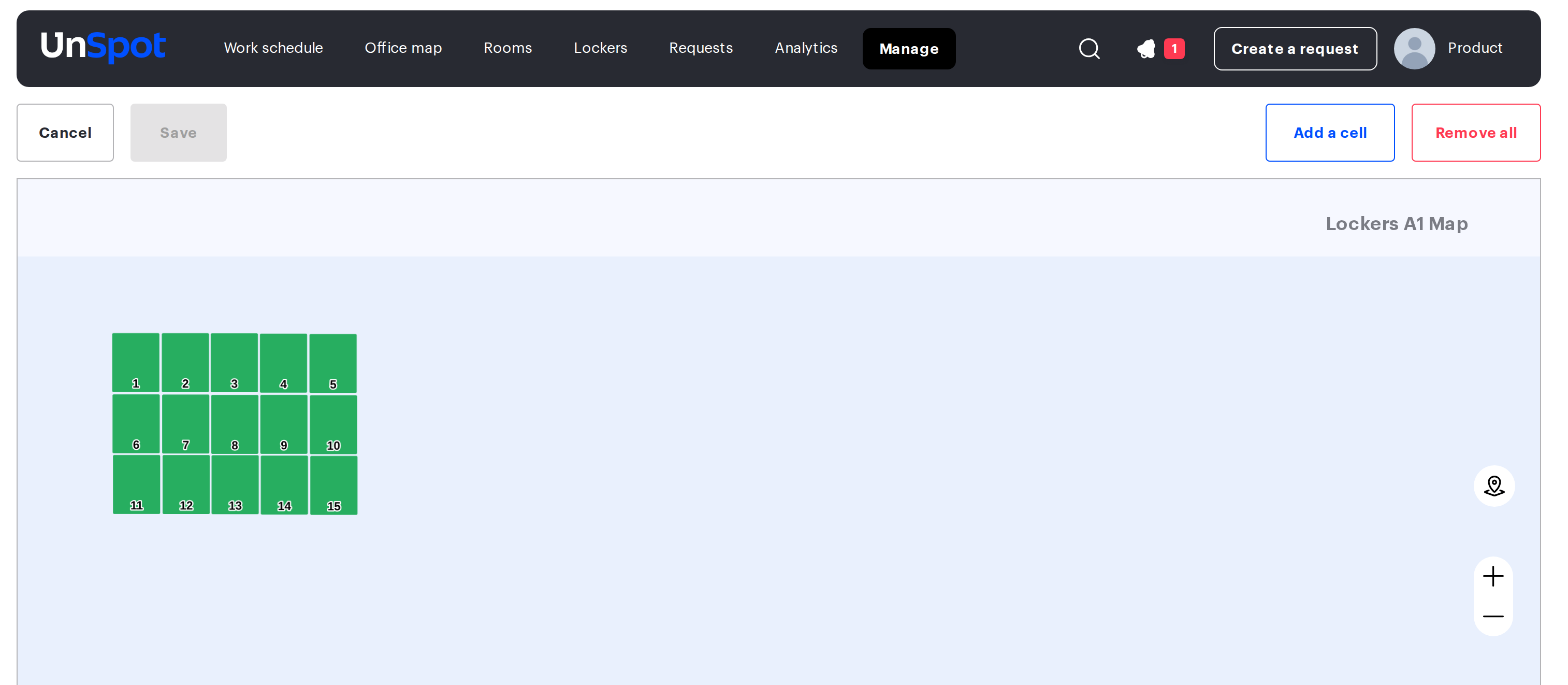
Cells are laid out in the locker map editor, which opens with the “Change map” button in the locker row. The main editor actions:
- uploading an image of the cabinet — the icon on the map panel, with the “Change the floor plan” tooltip: png or jpg, up to 5 MB. With no image uploaded the editor falls back to a blank canvas, so cells can still be placed;
- “Add a cell” — opens the cell form; placed cells can be moved, rotated and duplicated (one by one or in groups), and hovering over a cell shows the “Edit”, “Duplicate” and “Remove” actions;
- “Remove all” — deletes every cell together with the uploaded map image;
- “Save” — all editor changes are applied in one operation; before saving they can be discarded with “Cancel”. The list of keyboard shortcuts is available under the “Hotkeys” icon on the map panel.
The cell form:
- “Locker cell name” — 1 to 60 characters, unique within the locker (case-insensitive);
- “Cell type” — “Available to all” (the cell can be booked) or “Unavailable for booking” (the cell is shown on the map but cannot be booked — for example, while its lock is being repaired);
- “Access group” — the user groups whose members may take the cell; the default group is pre-selected when the cell is created. A cell with no access groups cannot be taken from the interface by anyone — the Super Administrator API-level bypass does not make it bookable on the Lockers page either;
- “Connection to Pocket Lock cell” — appears when the smart-lock integration is connected (see the section below).
Keep in mind. If an occupied cell is switched to “Unavailable for booking”, its current booking is removed when you save — the editor asks for a separate confirmation first.
How cell booking works
Employees work with cabinets on the Lockers page in the top bar. On the left is the list of cabinets: “Pinned lockers” (marked with a star, reordered by dragging) and “All lockers”; each cabinet shows a counter of free cells. On the right is the map of the selected cabinet with cell statuses: available, taken, taken by me, not available (the legend is under the hint icon). The “Go to …” button above the map opens the floor plan of the parent space.
- a cell booking is open-ended unless the locker has a booking horizon enabled: it has no end date, and the cell stays with the employee from the moment of booking until it is released. With the horizon on, the booking is removed automatically (see “Cell booking horizon”);
- one cell — one employee; any employee with access to the cell can take it. The Super Administrator role passes the access check at API level, but on the Lockers page a cell that is not open to their groups is shown as unavailable and has no booking button;
- a cell can be released by its owner, by an employee whose “Subordinates” setting covers all users, or by a manager who has the booking owner among their subordinates; the Super Administrator role alone does not grant this. If the booking was removed on the employee behalf, by the horizon policy, or the cell was disabled or deleted, they are notified through the channels of the “Created or deleted on my behalf” setting in the Booking section: email, push, Slack.
- an employee can book a cell not only for themselves but also for a colleague — on the “Colleague” tab of the free cell window. Availability of the tab depends on the company policy: when booking for others is allowed, every employee has the tab and any employee of the company can be picked; when it is not allowed, the tab is available only to those who have subordinates or whose subordinates setting covers all users, and only their own subordinates can be picked. The cell has to be available to the person who books it (an administrator always passes this check), while the colleague’s own access to the locker is not checked — and the colleague gets no notification about the booking.
Pocket Lock integration (smart locks)
UnSpot integrates with the Pocket Lock smart-lock system: physical cells of the controller are linked to locker cells, and employees open the lock right from the UnSpot interface. The full connection guide is in “Locker integration setup: Pocket Lock”; below is what matters while setting up the locker itself.
- the integration is connected in Manage → Integrations → Synchronisations, in the “Devices” section — available to the Super Administrator and Integrations Administrator roles;
- once connected, the cell form shows the “Connection to Pocket Lock cell” field — pick a free physical cell of the controller. One physical cell can be linked to only one UnSpot cell;
- a linked occupied cell gets the “Open locker” action. It is a short opening: the lock closes itself after 10 seconds, and the button can be pressed again 10 seconds later. Employees open their own cell; someone else occupied cell can be opened by a manager who has its holder among their subordinates, or by an employee whose “Subordinates” setting covers all users. A free cell has no button;
- UnSpot requests the cell states from the controller when a locker map is saved and an already existing cell was assigned an external cell, and additionally by a regular background job; the request runs asynchronously. The interface does not manage the schedule of that exchange;
- disconnecting the integration clears the lock link on every cell of every locker in the company, and they have to be matched again.
Keep in mind. While the integration is not connected, the cell form shows a hint with a link to the Integrations page instead of the selection field. There is no separate “close the cell” or “keep open” command in the interface. The requirements for the lock system API are described in “Locker integration: lock system API requirements”.
Editing and deleting
- changes are made on the locker page: “Edit information” for the name and the office, “Change settings” for the access groups, the booking horizon and private bookings; the name is re-checked for uniqueness within the space;
- “Remove” in the locker row deletes the cabinet together with all its cells and active bookings. No notification is sent in that case, unlike deleting a single cell in the map editor. Deletion cannot be undone;
- a space that still contains lockers cannot be deleted — delete or move its lockers first.
How lockers relate to other settings
| What | How it relates to lockers |
|---|---|
| User groups | Control the visibility of the cabinet (the locker access groups in the “Booking Rules” modal) and the right to take each cell (“Access group”) |
| Office map | A locker is placed on the floor plan via “Add elements” → “Locker” (picked from the lockers of the space); it can be hidden from the plan without deleting the cabinet itself |
| Reports | The locker log in the Reports section: who took or released a cell and when (BOOKED/RELEASED), how long the cell was held, and the action source (Desktop/Mobile, or System for horizon-driven removals) |
| Analytics | Cell occupancy is included in office workload analytics — on the lockers tab |
| Notifications | Removing a booking as an administrator, disabling or deleting a cell notifies the booking owner through the “Created or deleted on my behalf” channels |
| Deleting spaces | A space with lockers cannot be deleted — delete or move the lockers first |