
Company settings
General settings is the first tab of Manage → Company settings. It defines the branding and language of the service, turns UnSpot modules on and off for the whole company, and sets the time zone, date and time formats and default working hours. When you change values, the “You have unsaved changes” marker appears at the top of the page — remember to click Save. The Company settings section also contains other tabs: Work statuses, Work calendar, Booking approval and Booking policies.
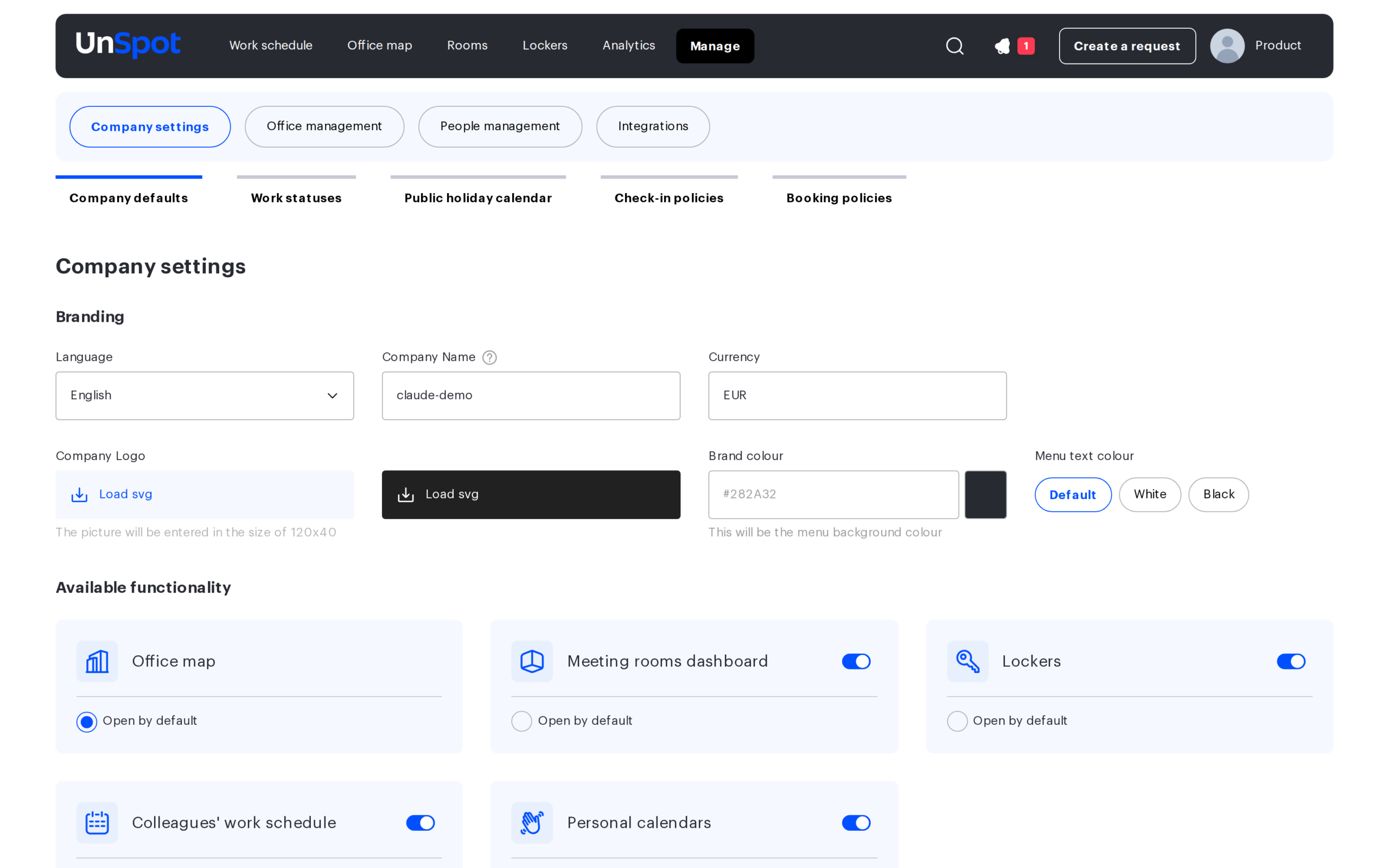
Branding
Service language
The default UnSpot interface language for the whole company. Available values: English, German. Employees see the service in this language until they pick their own language in their profile (Profile → Language) — the personal choice takes priority for them.
Company name
The displayed name of your company — 2 to 255 characters. It is used in UnSpot notification emails: the name tells the employee which workspace the notification came from. In addition, until a custom dark logo is uploaded, the name is shown on the sign-in page as a “for …” caption next to the UnSpot logo; after the logo is uploaded the caption disappears. The name does not affect the address or sign-in.
Currency
The currency label (up to 3 characters, for example EUR, USD or £) that is added to every cost field in the service — including external meeting-room rates and the remaining monthly credit. It is only a label next to the amounts: no conversion happens and calculations do not depend on it. If cost features are not used, the field can be left empty.
Company logo
Two SVG logos: a light one for dark backgrounds and a dark one for light backgrounds. The image is fitted into 120×40 — upload files with roughly these proportions, otherwise the logo will look small. Until your own file is uploaded, the standard UnSpot logo is shown everywhere.
Where each logo is used. The light and dark logos appear in different places, so it is worth uploading both:
- light — the top application menu for all employees (clickable, leads to the home page) and the header of the meeting-room panel screen (the UnSpot Space app on tablets at meeting rooms);
- dark — the mobile menu (on a light background), the sign-in page and the printable QR cards of desks and meeting rooms generated in the QR-codes section.
Keep in mind. “Light” and “dark” are slots, not automatic selection: the top menu always shows the logo from the light slot regardless of the chosen Brand colour. If you set a light brand colour, upload to the light slot a logo version that reads well on a light background. Notification emails do not use the company logo.
Brand colour and menu text colour
Brand colour is the company colour in HEX format (#RRGGBB). Until it is set, the interface uses the standard dark-graphite menu background #282A32. The ✕ button next to the field clears the chosen colour and returns the standard one.
Where the brand colour is applied. It is more than the menu background:
- the background of the top application menu and its drop-down panels (profile menu, mobile header);
- printable QR cards of desks and meeting rooms — the colour of the card title and the corner marks of the QR code;
- point-of-interest icons on the interactive office map.
Menu text colour is the colour of labels on the brand-colour background: “Default”, “White” or “Black”. “Default” is not automatic contrast — it is the standard dark-theme scheme (light text), so with a light brand colour choose “Black” explicitly, otherwise the menu items become unreadable for everyone. The choice also defines the hover highlight: a semi-transparent dark one for white text and a semi-transparent light one for black text.
Keep in mind. The colour applies to all employees immediately. Check the three settings together: brand colour + menu text colour + the logo in the light slot (that is the one shown in the menu) — all three must match. QR cards, on the contrary, use the dark logo: with a light brand colour the card title may look pale.
Available functionality
A block of toggles that defines which UnSpot modules the company’s employees see. A disabled module disappears from the top menu and becomes unavailable to employees. Its data is not deleted: maps, bookings and settings are preserved and reappear when the module is enabled again. This helps with phased roll-outs — enable modules as they become ready. Eight cards with toggles:
- Office map — building and floor maps, desk and parking booking;
- Meeting rooms dashboard — the Rooms page with the list and schedule of meeting rooms;
- Lockers — booking locker cells;
- Colleagues’ work schedule — the employees’ schedule with statuses (office, remote, vacation and so on);
- Personal calendars — the employee’s personal meeting calendar;
- Office Services — a card without a toggle, the module is always on;
- My requests — employees’ service requests;
- Visitor Management — guest visits and passes.
The “Open by default” radio button on a card sets the home page — the page employees land on after signing in. Pick the module employees use most, for example the office map in a hybrid schedule. The page must belong to an enabled module: if you disable that module, choose another start page.
Keep in mind. The toggles affect the whole company at once — a module cannot be hidden for only part of the employees (use roles and rights for that). Warn employees before disabling a module: their existing bookings and requests stay in the system but cannot be worked with through the interface while the module is off. Also check the “Open by default” page and the integrations tied to the module.
Date and time
Time zone
The company’s default time zone. Desk and meeting-room booking times are displayed in it, and the calendar days and weeks for the Booking policies limits are counted in it. The zone is inherited by all offices automatically; an individual office can get its own zone in its card on the map — bookings of that office then follow it. There is no fixed default — pick the zone when setting up the company. If your offices are in different time zones, give each office its own zone, otherwise employees will see booking times shifted.
Date and time formats
Date format: European (Day, Month, Year) or American (Month, Day, Year). Time format: 24-hour or 12-hour (AM/PM). The formats apply across the whole interface for all employees — in the schedule, bookings and reports. They do not affect data storage — only the display changes, so the formats can be switched safely at any time.
First day of the week
Which day the week starts with in calendars and the schedule: Monday or Sunday. It affects the display of calendars and date pickers only. Note: the weekly booking limits from Booking policies are always counted over the calendar week from Monday to Sunday — regardless of this setting.
Default employee working hours
The working hours (start and end, in HH:MM format) assigned to new employees by default. Every employee can change their own working time in the profile. The “Update working time for all employees” toggle applies the set hours to all existing employees at once — as a background job, the changes appear within a few minutes. The risk: the mass update overwrites the individual schedules employees have configured for themselves — use it deliberately.
Office working hours
The base office working hours (opening and closing time). They are inherited by all offices that have no hours of their own set in the office card. These hours feed analytics: meeting-room utilisation is calculated against the office working time, so understated or overstated hours distort the utilisation percentage in reports.
How the settings relate to each other
The settings of this tab are linked to each other and to other console sections — when changing one, check the related ones:
| Setting | What it is linked to |
|---|---|
| Service language | The personal language in the employee profile wins — for those who picked a language themselves, changing the company language does not change the interface |
| Company name | Notification emails; the “for …” caption on the sign-in page until a dark logo is uploaded |
| Currency | External meeting-room rates and the Monthly credit on the Booking policies tab |
| Logo (light) | Top menu; meeting-room panel (UnSpot Space); must be readable on the chosen Brand colour |
| Logo (dark) | Mobile menu; sign-in page; printable QR cards |
| Brand colour | Menu background and its panels; QR cards; points of interest on the map; combines with Menu text colour and the light logo |
| Open by default | Only pages of the modules enabled in Available functionality |
| Time zone | Day and week boundaries for the Booking policies limits; inherited by offices without their own zone |
| First day of the week | Calendars and date pickers; does not affect the weekly booking limits (they are always Mon–Sun) |
| Employee working hours | Default for new employees; the “Update for all” toggle overwrites personal schedules |
| Office working hours | Meeting-room utilisation in analytics; overridden in the office card |
Related articles
- Booking policies — booking limits, guest bookings, data retention and credit;
- Work statuses — configuring work-schedule statuses;
- User roles — who can change company settings.
- Service requests: overview — what the “My requests” card in “Available functionality” turns on
- Work schedule: section overview