
Reports
The Reports section contains 23 report types in five groups; one more report — the pass request history — is exported from the Visitors module. This article explains how to build a report and gives every report its own section: what it is for, its columns, data formats, possible values and examples.
Contents
Booking costs – Meeting rooms (external)
Booking history – Desks for guests
Booking history – Parking places
Booking history – Parking places for guests
Booking history – Meeting rooms
History of Office Visits (PACS)
Pass request history (Visitors module)
Administrator Action History group
History of Integration Management
History of Adding and Removing Locations (Desks, Parking, POI)
How to build a report
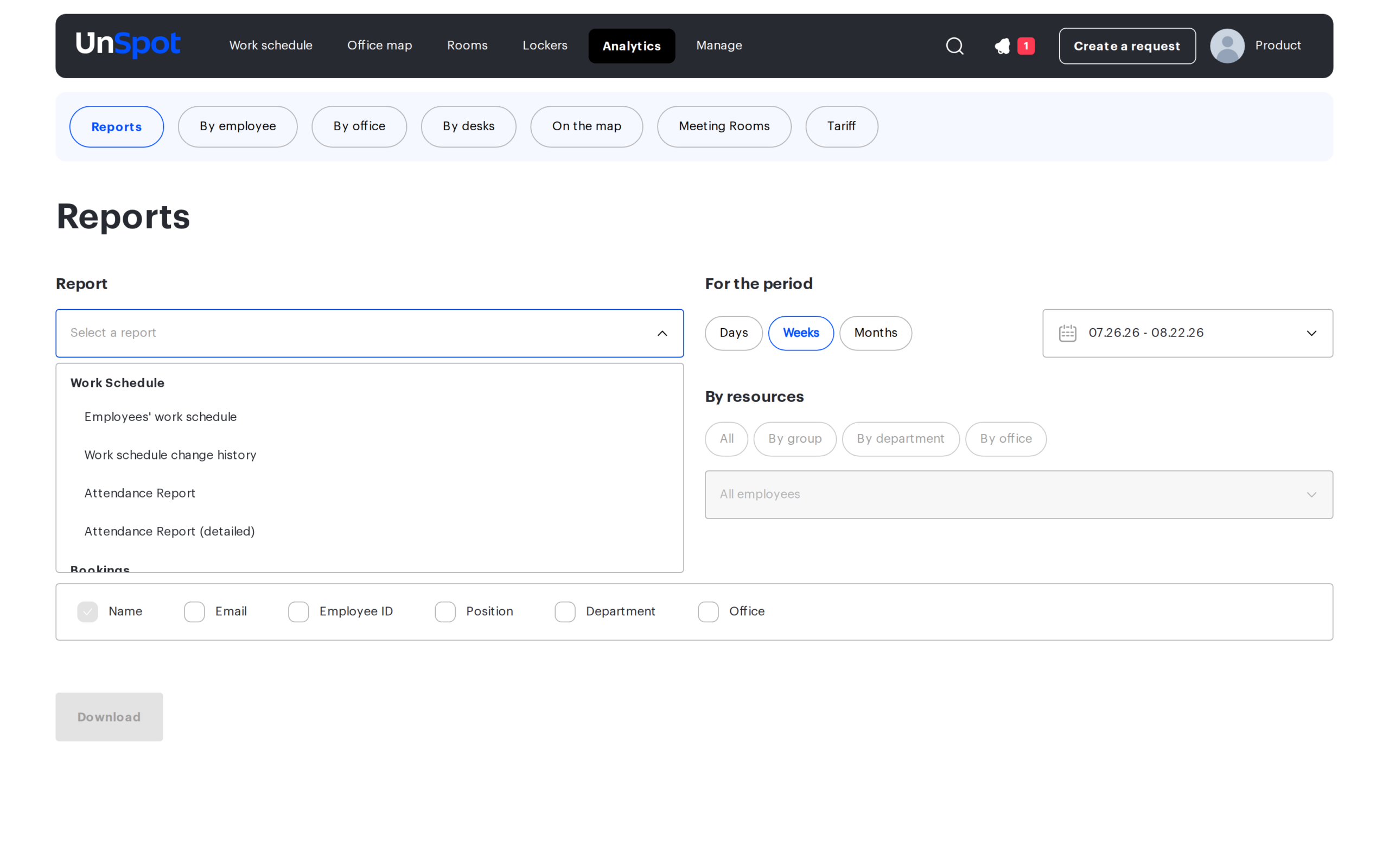
Open Analytics → Reports. The tab is available to every user: a regular employee builds reports about themselves (and their subordinates, if any), administrators — about everyone; administrative reports are visible only to the corresponding roles.
- Select the report type (the list is grouped — see the Contents above).
- Set the period.
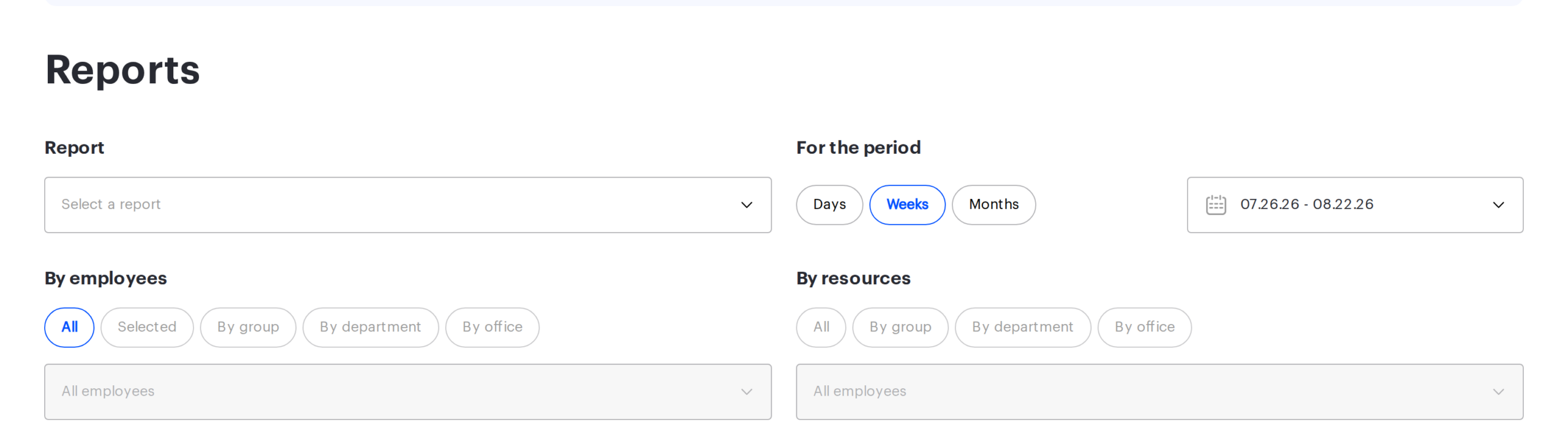
- Configure the “By employees” filter: All / Selected / By group / By department / By office. Booking reports additionally offer a “By resources” filter (by group, department or office).
- In the “Add employee details to report” block tick the fields you need: Name, Email, Employee ID, Position, Department, Office.
- Generate the report and download it as CSV (comma-separated in the English interface).
The “By group” tab of the “By employees” filter is not available to everyone (the tab is called “By group” only for the Super Administrator role; for everyone else, users, offices and integrations administrators included, it is labelled “By team”):
- if the employee card has “Subordinates” set to “All users”, the tab is available and the list holds all groups of the company except the service group that covers all users;
- if that setting is not there but the employee is assigned as the manager of at least one team, the tab is available too, yet the list holds only the groups where they are named the team manager;
- with neither of the two, the tab is visible but disabled — nothing can be picked in it.
The select placeholder is “Select groups” (“Select teams” in the “By team” variant). For the “History of Adding and Removing Locations” report only “All” and “Selected” stay active in the “By employees” filter, no matter the rights, while “By group”, “By department” and “By office” are disabled — this is noted in the description of that report below. The tab of the same name in the “By resources” filter works differently and has not changed: its list always holds only the groups where the employee is the team manager.
If the period includes future dates, the file starts with the warning “Booking information for the upcoming dates may change.”
Employee fields in reports
The employee columns (Name, Email, Employee ID, Position, Department, Office) are enabled by the checkboxes of the “Add employee details to report” block and come from the employee profile. In log reports they appear with a role prefix: Initiator fields — who performed the action, Owner / User fields — whose booking, schedule or profile it is. If a checkbox is not ticked or the profile field is empty, the cell shows “-” or stays empty. The tables below list these columns explicitly for every report.
Work Schedule group
Employees’ work schedule
An “employee × days” matrix: each employee’s status on each day of the period. Helps you see how complete the schedule is and plan seating. The first row (above the header) is “Total employees” — how many people are in the Office status on each day.
| Column | Format | What it contains and why | Example |
|---|---|---|---|
| Name, Email, Employee ID, Position, Department, Office | text | Employee data from the profile (set of columns is defined by the checkboxes). | John Smith |
| Date columns (one per day) | header DD.MM.YYYY; cell — status | Day status. Possible values: • Office or an office name; • Remote; • Not working; • the name or code of a custom status (e.g. OFF); • Weekend — weekend or holiday; • “-“ — the booking was cancelled (e.g. by check-in); • empty — the day is not filled in. | Office |
| Total visits | number | How many days in the period the employee was in the office. | 12 |
Work schedule change history
A log of who set which schedule status, when and from where. One row — one change of one day.
| Column | Format | What it contains and why | Example |
|---|---|---|---|
| Action date | DD.MM.YYYY HH:mm | When the change was made. | 17.07.2026 07:00 |
| Action type | operation code | Always update — a day status change. | update |
| Action site | channel name | Where the change came from. Main values: • Schedule (Desktop/Mobile); • Office map (Desktop/Mobile); • My bookings (Desktop/Mobile); • Slack, Push, Email; • Template — automatic fill from the work schedule template; • From working schedule template; • External API; • system. | Template |
| Initiator Name, Email, Department | text | Who made the change; “-” — the change was made by the system (e.g. by template). | John Smith |
| Date of schedule | DD.MM.YYYY | Which schedule date was changed (not to be confused with the Action date). | 20.07.2026 |
| Status | text | The status that was set; for custom statuses — their company-defined name. | Sick Leave 2 |
| Parent Status | text | The base status the set status belongs to: Office / Remote / Not working. | Not working |
| Owner Name, Email, Employee ID, Position, Department, Office | text | Whose schedule was changed. | Emma Miller |
Attendance Report
An “employee × days” matrix with per-employee aggregates — the main tool for tracking the office attendance target. The first row (above the header) is “Total employees” per day.
| Column | Format | What it contains and why | Example |
|---|---|---|---|
| Name, Email, Employee ID, Position, Department | text | Employee data (set by checkboxes); the Office column appears after the aggregates, not at the beginning. | John Smith |
| Date columns (one per day) | header DD.MM.YYYY; cell — status | Day status: • Office; • Remote; • Not working; • Weekend — weekend/holiday; • “-“ — booking cancelled; • empty — day not filled in. | Office |
| Number of Office / Remote / Non-Working / Unreported / Weekends and Holidays days | number (5 columns) | How many days of each type accumulated over the period. | 9 / 8 / 2 / 1 / 8 |
| Office | text | The office the employee is assigned to. | London |
| Office attendance target (%) | percent | The target share of office days set for the employee or the company. | 60 |
| Office attendance target (baseline) | days | How many office days the target requires out of all working days of the period. | 12 |
| Office attendance target (actual) | days | How many office days the target requires out of the days actually filled in. | 10 |
| Baseline difference / Actual difference | ±days (2 columns) | Deviation of the fact from the target: a negative value means missing office days. | -2 / -1 |
Attendance Report (detailed)
The same Attendance Report, but detailed by sub-statuses — for when you need to see not just “Non-working”, but exactly which status was set.
| Column | Format | What it contains and why | Example |
|---|---|---|---|
| Name, Email, Employee ID, Position, Department | text | Employee data (set by checkboxes). | John Smith |
| Date columns | header DD.MM.YYYY; cell — detailed status | Instead of a generic status: • the office name or place code (e.g. F-12) for an office day; • the code/name of a custom status (e.g. OFF); • Weekend; • “-“ — booking cancelled; • empty — not filled in. | F-12 |
| Number of Office / Remote / Non-Working / Unreported / Weekends and Holidays days | number (5 columns) | Aggregates by the base day types. | 9 / 8 / 2 / 1 / 8 |
| Days per each sub-status | number (a column per custom status) | For example, “Number of Non-Working Days “Day Off””, “Number of Non-Working Days “Sick Leave 2″” — for every custom status of the company. | 3 |
| Office | text | The office the employee is assigned to. | London |
| Office attendance target (%) / (baseline) / (actual) | percent; days | The office-days target and its conversion into days — from all working days and from the filled-in days. | 60 / 12 / 10 |
| Baseline difference / Actual difference | ±days (2 columns) | Deviation of the fact from the target. | -2 / -1 |
Bookings group
Bookings – Desks
A list of all desk bookings for the period: one row — one booking. Answers “who occupied which desk and when”.
| Column | Format | What it contains and why | Example |
|---|---|---|---|
| Start | YYYY-MM-DD HH:mm | Booking start. Time is in the timezone of the user who builds the report. | 2026-07-31 16:00 |
| End | YYYY-MM-DD HH:mm | Booking end. | 2026-08-01 01:00 |
| Duration | hh:mm:ss | Booking duration. | 09:00:00 |
| Space | text | Where the desk is: office/floor/zone name. | Office |
| Place | text | Desk number or name. | 38 |
| Owner Name, Email, Employee ID, Position, Department, Office | text | Whose booking it is (set by checkboxes). | Lukas Fernandes |
| Visitor name | text | Filled in when the booking was created for a guest rather than an employee. | Peter Guest |
Bookings – Parking places
A list of parking bookings for the period, including car data — convenient to hand over to the security checkpoint.
| Column | Format | What it contains and why | Example |
|---|---|---|---|
| Start / End | YYYY-MM-DD HH:mm (2 columns) | Booking period in the report author’s timezone. | 2026-07-31 09:00 |
| Duration | hh:mm:ss | Booking duration. | 09:00:00 |
| Space | text | Parking/zone name. | Parking |
| Place | text | Parking place number. | P-134 |
| Owner Name, Email, Employee ID, Position, Department, Office | text | Whose booking it is (set by checkboxes). | Robert Thompson |
| Visitor name | text | Filled in for guest bookings. | Peter Guest |
| Make and model of the user’s car | text | Car make and model from the employee profile. | BMW X6 |
| User License plate number | plate number | Car registration number. | ABC-1234 |
| Message For Owner / Message for host | text (2 columns) | Comments entered when creating a guest parking booking. | Guest arrives at 10:00 |
Bookings – Meeting rooms
A list of meeting room bookings for the period: room utilization, meeting subjects and the cost of paid (external) rooms.
| Column | Format | What it contains and why | Example |
|---|---|---|---|
| Start / End | YYYY-MM-DD HH:mm (2 columns) | Meeting period in the report author’s timezone. | 2026-07-20 10:00 |
| Duration | hh:mm:ss | Meeting duration. | 01:30:00 |
| Cost of the booking | number | Booking cost of a paid (external) meeting room by its hourly rate; empty for regular rooms. | 40 |
| Space | text | Office/floor where the room is. | London, Floor 3 |
| Meeting room | text | Room name. | Jupiter |
| Owner Name, Email, Employee ID, Position, Department, Office | text | Who booked (set by checkboxes). | John Smith |
| Meeting name | text | Meeting subject from the booking or a connected calendar. | Sprint review |
| Comment | text | Booking comment. | Projector needed |
Booking time – Desks
An “employee × days” matrix: how long desks were booked by each employee on each day. Shows the real utilization of desks.
| Column | Format | What it contains and why | Example |
|---|---|---|---|
| Name, Email, Employee ID, Position, Department, Office | text | Employee data (set by checkboxes). | John Smith |
| Date columns | hh:mm:ss | Total booking duration of the employee for that day. | 02:30:00 |
| Total hours | hh:mm:ss | Per-employee total for the period. | 41:30:00 |
| total hours | hh:mm:ss (top row) | Total across all employees for each day — the row above the header. | 99:00:00 |
Booking time – Parking places
The same “employee × days” matrix, but for parking bookings.
| Column | Format | What it contains and why | Example |
|---|---|---|---|
| Name, Email, Employee ID, Position, Department, Office | text | Employee data (set by checkboxes). | John Smith |
| Date columns | hh:mm:ss | Total parking booking duration for the day. | 09:00:00 |
| Total hours | hh:mm:ss | Per-employee total for the period. | 41:30:00 |
| total hours | hh:mm:ss (top row) | Total across all employees for each day. | 99:00:00 |
Booking time – Meeting rooms
The same “employee × days” matrix, but for meeting room bookings: how much meeting time each employee had on each day.
| Column | Format | What it contains and why | Example |
|---|---|---|---|
| Name, Email, Employee ID, Position, Department, Office | text | Employee data (set by checkboxes). | John Smith |
| Date columns | hh:mm:ss | Total meeting room booking duration for the day. | 01:30:00 |
| Total hours | hh:mm:ss | Per-employee total for the period. | 12:00:00 |
| total hours | hh:mm:ss (top row) | Total across all employees for each day. | 18:00:00 |
Booking costs – Meeting rooms (external)
An “employee × days” matrix for paid (external) meeting rooms: how much each employee’s bookings cost on each day. Used for internal cost allocation for paid rooms.
| Column | Format | What it contains and why | Example |
|---|---|---|---|
| Name, Email, Employee ID, Position, Department, Office | text | Employee data (set by checkboxes). | John Smith |
| Date columns | number | Total cost of external room bookings for the day (by the room’s hourly rate). | 120 |
| Totally per user | number | Per-employee total for the period. | 560 |
| Totally per day | number (top row) | Total across all employees for each day. | 1680 |
Bookings history group
Logs of booking operations: one row — one action (creation, change, cancellation, check-in). In all reports of the group the “Action type” column takes the values:
- CREATED — the booking was created;
- UPDATED — the booking was changed;
- DELETED — the booking was deleted or cancelled;
- STOPPED — the booking was ended early;
- CHECKED IN (REMOTE) and CHECKED IN (IN OFFICE) — booking confirmation (check-in);
- System — the action was performed by the system.
The “Action site” column shows the channel the action came from:
- application interfaces — Schedule (Desktop/Mobile), Office map (Desktop/Mobile), My bookings (Desktop/Mobile), Meeting rooms (Desktop/Mobile), Global search (Desktop/Mobile), Inbox;
- integrations and notifications — Slack, Push, Email, Quick link, Qr code / QRCode, Calendar sync, Meeting room display, External API, PACS;
- booking confirmation — Check-in, Checked in (Remote), Checked in (In office), My bookings;
- automatic actions — Assigned place, Template, From working schedule template, Offices: drag&drop, system delegate, system_sync / system_sync by SCIM, Data removed from system.
Booking history – Desks
The full log of desk booking operations: who created, changed, cancelled or checked in a booking, when and from which channel.
| Column | Format | What it contains and why | Example |
|---|---|---|---|
| Action date | YYYY-MM-DD HH:mm | When the action happened. | 2026-07-04 04:00 |
| Action type | text | What was done with the booking: • CREATED — created; • UPDATED — changed; • DELETED — deleted or cancelled; • STOPPED — ended early; • CHECKED IN (REMOTE) / CHECKED IN (IN OFFICE) — check-in; • System — a system action. | CREATED |
| Action site | channel name | The channel of the action — the full value list is given in the group description above; empty — the channel was not recorded. | Assigned place |
| Initiator Name, Email, Department | text | Who performed the action (the owner, a colleague or an administrator). | John Smith |
| Booking ID | UUID | Internal booking identifier — for API matching and support requests. | 1844da6c-a0ac-… |
| Start / End | YYYY-MM-DD HH:mm (2 columns) | The period of the booking itself (not of the action). | 2026-07-31 09:00 |
| Duration | hh:mm:ss | Booking duration. | 09:00:00 |
| Space | text | Office/floor/zone of the desk. | Floor – 12 |
| Place | text | Desk number or name. | 1 |
| Owner Name, Email, Employee ID, Position, Department, Office | text | Whose booking it is (set by checkboxes). | John Smith |
Booking history – Desks for guests
The log of guest desk booking operations — which employees booked desks for guests.
| Column | Format | What it contains and why | Example |
|---|---|---|---|
| Action date | YYYY-MM-DD HH:mm | When the action happened. | 2026-07-04 04:00 |
| Action type | text | What was done with the booking: • CREATED; • UPDATED; • DELETED; • STOPPED; • CHECKED IN (REMOTE) / CHECKED IN (IN OFFICE); • System. | CREATED |
| Action site | channel name | The channel of the action — see the full list in the group description. | Office map (Desktop) |
| Initiator Name, Email, Department | text | Who performed the action. | John Smith |
| Booking ID | UUID | Booking identifier. | b5818056-7402-… |
| Start / End | YYYY-MM-DD HH:mm (2 columns) | Booking period. | 2026-07-31 09:00 |
| Duration | hh:mm:ss | Booking duration. | 09:00:00 |
| Space | text | Office/floor/zone of the desk. | Office |
| Place | text | Desk number. | 38 |
| Owner Name, Email | text (2 columns) | The guest the booking was created for (name and email only). | Peter Guest |
| Message For Owner | text | Comment entered when creating the guest booking. | Guest arrives at 10:00 |
Booking history – Parking places
The log of parking booking operations, including car data.
| Column | Format | What it contains and why | Example |
|---|---|---|---|
| Action date | YYYY-MM-DD HH:mm | When the action happened. | 2026-07-17 04:00 |
| Action type | text | What was done with the booking: • CREATED; • UPDATED; • DELETED; • STOPPED; • CHECKED IN (REMOTE) / CHECKED IN (IN OFFICE); • System. | UPDATED |
| Action site | channel name | The channel of the action — see the full list in the group description; empty — the channel was not recorded. | Push |
| Initiator Name, Email, Department | text | Who performed the action. | Francesca Amati |
| Booking ID | UUID | Booking identifier. | b5818056-7402-… |
| Start / End | YYYY-MM-DD HH:mm (2 columns) | Booking period. | 2026-07-31 09:00 |
| Duration | hh:mm:ss | Booking duration. | 09:00:00 |
| Space | text | Parking/zone. | Parking |
| Place | text | Parking place number. | MP-P-15 |
| Owner Name, Email, Employee ID, Position, Department, Office | text | Whose booking it is (set by checkboxes). | Francesca Amati |
| Make and model of the user’s car | text | Car make and model from the employee profile. | Kia Rio |
| User License plate number | plate number | Car registration number. | ABC-1234 |
| Message For Owner / Message for host | text (2 columns) | Guest parking booking comments. | Guest arrives at 10:00 |
Booking history – Parking places for guests
The log of guest parking booking operations.
| Column | Format | What it contains and why | Example |
|---|---|---|---|
| Action date | YYYY-MM-DD HH:mm | When the action happened. | 2026-07-17 04:00 |
| Action type | text | What was done with the booking: • CREATED; • UPDATED; • DELETED; • STOPPED; • CHECKED IN (REMOTE) / CHECKED IN (IN OFFICE); • System. | CREATED |
| Action site | channel name | The channel of the action — see the full list in the group description. | Office map (Desktop) |
| Initiator Name, Email, Department | text | Who performed the action. | John Smith |
| Booking ID | UUID | Booking identifier. | b5818056-7402-… |
| Start / End | YYYY-MM-DD HH:mm (2 columns) | Booking period. | 2026-07-31 09:00 |
| Duration | hh:mm:ss | Booking duration. | 09:00:00 |
| Space | text | Parking/zone. | Parking |
| Place | text | Parking place number. | P-154 |
| Owner Name, Email | text (2 columns) | The guest the booking was created for. | Peter Guest |
| Make and model of the user’s car / User License plate number | text; plate number | The guest’s car specified when the booking was created. | BMW X6 / XYZ-5678 |
| Message For Owner / Message for host | text (2 columns) | Guest booking comments. | Guest arrives at 10:00 |
Booking history – Meeting rooms
The log of meeting room booking operations: meeting changes, cancellations, calendar sync actions. Actions without a channel (e.g. automatic ones) are recorded as system.
| Column | Format | What it contains and why | Example |
|---|---|---|---|
| Action date | YYYY-MM-DD HH:mm | When the action happened. | 2026-07-10 12:00 |
| Action type | text | What was done with the booking: • CREATED; • UPDATED; • DELETED; • STOPPED; • CHECKED IN (REMOTE) / CHECKED IN (IN OFFICE); • System. | DELETED |
| Action site | channel name | The channel of the action — see the full list in the group description (for meeting rooms typically Meeting rooms (Desktop), Calendar sync, Meeting room display). | Calendar sync |
| Initiator Name, Email, Department | text | Who performed the action; system — an automatic action. | John Smith |
| Booking ID | UUID | Booking identifier. | 1844da6c-a0ac-… |
| Start / End | YYYY-MM-DD HH:mm (2 columns) | Meeting period. | 2026-07-20 10:00 |
| Duration | hh:mm:ss | Meeting duration. | 01:30:00 |
| Space | text | Office/floor of the room. | London, Floor 3 |
| Booking meeting room | text | Room name (instead of the Place column). | Jupiter |
| Owner Name, Email, Employee ID, Position, Department, Office | text | Whose meeting it is (set by checkboxes). | John Smith |
| Meeting name | text | Meeting subject from the booking or calendar. | Sprint review |
| Booking price | number | Booking cost of a paid (external) room; empty for regular rooms. | 40 |
Booking history – Locker
The log of occupying and releasing storage lockers. Unlike the other logs of the group, here “Action type” takes the values BOOKED — the locker cell was occupied and RELEASED — the cell was released, and “Action site” is Desktop or Mobile (which interface the action came from).
| Column | Format | What it contains and why | Example |
|---|---|---|---|
| Action date | YYYY-MM-DD HH:mm | When the action happened. | 2026-06-05 13:21 |
| Action type | BOOKED / RELEASED | The cell was occupied or released. | BOOKED |
| Action site | Desktop / Mobile | Which interface the action came from. | Desktop |
| Initiator Name, Email, Department | text | Who performed the action. | Robert Thompson |
| Start | YYYY-MM-DD HH:mm | When the cell was occupied. There is no Booking ID column in this report. | 2025-07-14 11:43 |
| End | YYYY-MM-DD HH:mm | When the cell was released; empty while the cell is in use. | 2026-06-05 13:21 |
| Duration | N d N h | How long the cell has been in use — in days and hours (not hh:mm:ss). | 296 d 23 h |
| Space | text | Office/floor where the locker stands. | Office |
| Locker | text | Cabinet name. | Lockers A1 |
| Storage locker | text | Cell number in the cabinet. | 10 |
| Owner Name, Email, Employee ID, Position, Department, Office | text | Who uses the cell (set by checkboxes). | Robert Thompson |
User Action History group
History of Report Downloads
Who downloaded which reports — control over access to personal data. The log records downloads not only from the Reports section but also from other parts of the application (e.g. meeting room booking history, visitor reports, schedule filling history).
| Column | Format | What it contains and why | Example |
|---|---|---|---|
| Action Date | DD.MM.YYYY HH:mm | When the report was downloaded. | 17.07.2026 11:00 |
| Action site | text | Name of the downloaded report. | Booking history – Meeting rooms |
| Initiator Name, Email, Employee ID, Position, Department, Office | text | Who downloaded the report (set by checkboxes). | Robert Thompson |
| Report period (from) / Report period (till) | DD.MM.YYYY (2 columns) | The period the downloaded report was built for. | 01.05.2026 / 31.07.2026 |
| Number of users | number | How many employees were included in the downloaded report — an estimate of the amount of exported personal data. | 8 |
History of Logins
Authorization audit: successful and failed sign-in attempts, precise to the second.
| Column | Format | What it contains and why | Example |
|---|---|---|---|
| Action date | YYYY-MM-DD HH:mm:ss | The moment of the sign-in attempt (with seconds). | 2026-07-14 12:53:25 |
| IP address | IPv4/IPv6 | The address the sign-in came from. | 203.0.113.17 |
| User-agent | browser string | Browser/device of the sign-in. | Mozilla/5.0 (Macintosh…) Chrome/150 |
| Authorization method | text | Sign-in method: • password; • google, microsoft, apple — sign-in via the corresponding SSO provider; • oauth2 — corporate SSO (OAuth2/OIDC); • login <email> — the administrator with that email signed in as this user (impersonation). | |
| Authorization result | Success / Fail | Whether the sign-in succeeded; a series of Fail entries is a reason to check the account. | Success |
| User Name, Email, Employee ID, Position, Department, Office | text | Who signed in (set by checkboxes). | John Smith |
| User Role | text | Role at the moment of sign-in: • Super Administrator • Office manager • Offices Administrator • Users Administrator • Integrations Administrator • Member • Device • Reception With a Fail result, and also for a successful sign-in with no recorded role, the column contains a dash (-). | Super Administrator |
History of Office Visits (PACS)
Actual office visits based on presence control data: access control systems, QR codes, geolocation and other confirmation sources.
| Column | Format | What it contains and why | Example |
|---|---|---|---|
| Action date | DD.MM.YYYY HH:mm | The moment of the visit mark. | 15.07.2026 09:12 |
| Action Type | text | Technical status of the presence mark (e.g. in_office — the employee is in the office). | in_office |
| Action Source | text | Where the event came from: • PACS notification — access control system; • QR code scanned; • Location detection — WiFi/IP/GPS; • Remote confirmation — the remote confirmation button; • CSV upload — manual data upload; • External notification — other external notifications. | PACS notification |
| Owner Name, Email, Employee ID, Position, Department, Office | text | Whose visit it is (set by checkboxes). | John Smith |
Pass request history (Visitors module)
The log of guest pass requests. It is exported from the Visitors module (the download button in the request list); the downloads are also recorded in the History of Report Downloads.
| Column | Format | What it contains and why | Example |
|---|---|---|---|
| Action date | DD.MM.YYYY HH:mm | When the request was changed. | 29.06.2026 13:36 |
| Request status | text | Current status: • New request — created and waiting to be processed; • Pass ordered — the request was approved; • Rejected — the request was rejected (including automatically, if it was not processed before the visit date). | Rejected |
| Initiator Name, Email, Employee ID, Position, Department, Org Unit, Office | text | Who created the request. | Robert Thompson |
| Visitor name / Visitor email | text (2 columns) | The guest the pass is ordered for. | Jane Visitor |
| Visit date | DD.MM.YYYY | The date the pass is ordered for. | 29.06.2026 |
| Visit office | text | Which office the guest will visit. | London |
| Host Name, Email, Employee ID, Position, Department, Org Unit, Office | text | The employee who meets the guest. | Robert Thompson |
Administrator Action History group
History of User Management
Who changed what in employee profiles and when — manually or by synchronization.
| Column | Format | What it contains and why | Example |
|---|---|---|---|
| Action date | YYYY-MM-DD HH:mm | When the change was made. | 2026-07-16 15:18 |
| Action type | operation code | What was done with the profile: • created; • updated; • deleted. | updated |
| Source of change | text | Where the change came from: • admin — manually by an administrator; • system_sync — directory synchronization (AD, Google WS, etc.); • system_sync by SCIM — SCIM synchronization. | admin |
| Initiator Name, Email, Department | text | Who made the change. | Robert Thompson |
| User Name, Email, Employee ID, Position, Department, Office | text | Whose profile was changed. | John Smith |
| Modified fields | technical field names, comma-separated | Which profile fields were affected; system field names are shown (e.g. language — interface language, position — job title). | language |
History of Integration Management
Changes to integration settings: who enabled, disabled or reconfigured what.
| Column | Format | What it contains and why | Example |
|---|---|---|---|
| Action date | DD.MM.YYYY HH:mm | When the change was made. | 15.07.2026 12:03 |
| Action type | operation code | What was done with the setting (create, update, delete). | updated |
| Integration System | text | Which integration system was changed (Slack, SCIM, PACS, etc.). | Slack |
| Initiator Name, Email, Employee ID, Position, Department, Office | text | Who changed the setting (set by checkboxes). | Robert Thompson |
| Additional information | text | Operation details: what exactly was enabled, disabled or reconfigured. | Subscription disabled |
History of Adding and Removing Locations (Desks, Parking, POI)
Changes to objects on office maps: when desks, parking places and info objects appeared and were removed.
Filter note: for this report, only the All and Selected tabs are available in the “By employees” filter — the other tabs (By group, By department, By office) are disabled.
| Column | Format | What it contains and why | Example |
|---|---|---|---|
| Action date | DD.MM.YYYY HH:mm | When the change was made. | 15.07.2026 12:03 |
| Action type | operation code | Adding or removing an object. | created |
| Object type | text | What kind of object: desk, parking place or info object (POI). | Desk |
| Object name | text | The object’s name on the map. | 77 |
| Office | text | The office on whose map the object was changed. | London |
| Initiator Name, Email, Employee ID, Position, Department, Office | text | Who changed the map (set by checkboxes). | Robert Thompson |
Who can see which reports
- Standard reports (schedule, bookings, booking histories) are available to everyone; the data is limited by visibility scope — yourself and your subordinates, administrators see everyone.
- Administrative reports are visible to the Super administrator and Office manager; additionally the User administrator sees the History of User Management, and the Integration administrator — the History of Integration Management.
- The pass request history is available from the Visitors module to the roles working with guest passes.
💡 Resource settings exports (desk lists, parking, QR codes) live elsewhere: Settings → Office management → Resources report.