
Meeting Rooms analytics: room workload
The Meeting Rooms tab of the Analytics section answers one question: how many hours each meeting room was booked over the selected period. It is not an occupancy percentage and not an office summary, but a plain ranking of rooms by total booking time — a convenient way to find the rooms you need more of and the ones that stand empty. This article covers the whole tab: who can see it, what the chart shows, what enters the calculation, how to export the data and how the tab differs from the meeting rooms block on the By office tab.
Who can see the tab
The Meeting Rooms tab is available to the Super Administrator, Office manager, Offices Administrator and Integrations Administrator roles. A regular employee does not see it. The Users Administrator role does not see the tab in the tab bar, but the page still opens for them by a direct link.
⚠️ There is no link to the tab in the side menu — only the tab bar of the Analytics section. On a narrow screen, where the tab bar is hidden, the tab is unreachable.
How to open it and what to set
Open Analytics → Meeting Rooms. There are only two settings.
| Control | What it does | Default |
|---|---|---|
| Office selector | the office tree; ⚠️ the cross clears the filter caption, but the chart stays on the office selected earlier — to go back to all offices, reload the page | All offices |
| Period | a calendar with grouping switches | from “today minus four weeks” to yesterday |
Next to them sits a reference counter, Weekday / Weekend. ⚠️ It does not affect the chart figures — the chart counts every calendar day of the period, see below.
- ⚠️ The office filter takes the office and its direct children, but no deeper levels. If a building has floors and the floors have their own premises, third-level rooms will not enter the report.
- ⚠️ The office list contains every office, including those with no meeting rooms. For such an office the report shows the message No meeting rooms in this office.
- ⚠️ There is no limit on the length of the period. You can request a year; the page will take a long time to respond. This differs from the By office, By employee and By desks tabs, where the period is capped at three months.
The “Meeting room usage” chart
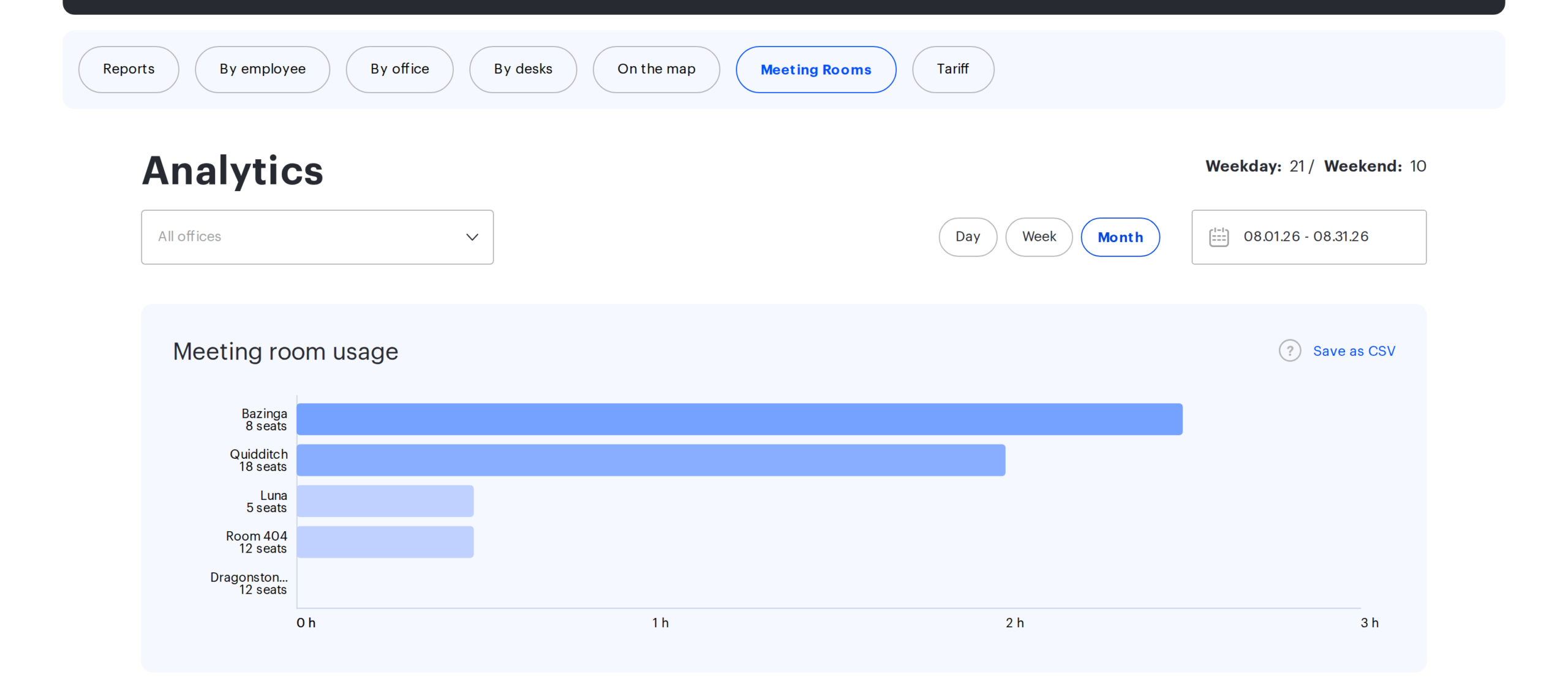
This is the only block on the tab. Horizontal bars, one per room; the length of a bar is the total booking time over the period. The hint under the heading explains it: Total booking time for each meeting room.
- Vertically — the meeting rooms, labelled on two lines: the room name and its capacity.
- Horizontally — hours, with the ticks marked h.
- Sorting — descending by hours: the busiest rooms are on top.
- The colour of a bar is the more saturated the closer the room is to the maximum in the selection.
⚠️ These are absolute hours, not an occupancy percentage. The chart divides them neither by working hours nor by the number of days, so comparing rooms with each other is only valid within one period, and this chart cannot support a statement like “the room is N% loaded”. For the percentage picture use the By office tab.
⚠️ The room name on the chart is truncated to ten characters with an ellipsis. Rooms whose names share a beginning (“Meeting room 1”, “Meeting room 2”) become indistinguishable in the labels — full names are only visible in the CSV export.
Rooms with zero time do not disappear from the list: they get a bar of zero length. This is useful — the rooms nobody used at all are visible immediately.
What enters the calculation
| What | Counted |
|---|---|
| Ordinary meeting room bookings made in UnSpot | yes |
| Meetings from external calendars (Exchange, Google, Microsoft) | yes, on a par with UnSpot bookings |
| A booking the user ended early | yes, at its actual duration — up to the moment the room was released |
| A booking released automatically for a missing check-in | no |
| A cancelled booking | no |
| Hours outside the office working time | yes, all 24 hours of the day are counted |
| Weekends and public holidays | yes, they are not excluded |
A booking ended early is counted by its actual duration. If a meeting was booked for two hours and the user released the room after twenty minutes, twenty minutes enter the report: on an early finish the system rewrites the end time of the booking, and the chart takes exactly that value. The planned end is stored separately but does not go into this report. A room released because of a missing check-in is a different case — such bookings are not counted at all.
Multi-day bookings are split by day, and each day is counted separately. ⚠️ The split is capped at eleven days: for a longer booking the first eleven days enter the report and the remaining hours are dropped. For meeting rooms this is rare, but it happens with a booking made “for the whole summer” to hold a recurring activity.
A booking has no separate all-day flag: a booking from 00:00 to 00:00 of the next day is counted as 24 hours for the first day and zero for the second.
Times are converted to the office time zone when the office has the default settings switched off and its own time zone and working hours defined; otherwise the company time zone is used.
How to convert hours into a load figure
The tab does not calculate a percentage, but you can derive one from its figures by hand — with one caveat. The potential of a room over the period is the length of the working day multiplied by the number of working days. With a nine-hour working day and a period of 20 working days the potential of a single room is 180 hours; a room that collected 54 hours is busy roughly 30% of the time.
⚠️ The caveat is that the numerator and the denominator come from different calculations: the hours of this tab include evening and weekend bookings, while the potential you calculate is based on working hours. For a room that is actively booked in the evenings the share can even exceed 100%. Treat such an estimate as a rough guide; a ready-made occupancy percentage is given by the meeting rooms block on the By office tab.
| What you see | What it means | What to do |
|---|---|---|
| One or two rooms collect several times more hours than the rest | people need a specific capacity, equipment or floor, not “a meeting room” in general | look at the capacity of the leaders — it is labelled on the chart — and use it as the guide when buying more |
| The top of the list is close to its potential while the bottom is almost empty | the rooms are unequal rather than scarce | walk through the lower part of the list: a zero-length bar is a room people see and do not take |
| Many hours on rooms with a large capacity | large rooms are taken for meetings of two | cross-check with the room attendance and meeting duration breakdowns on the By office tab |
| Every room has few hours, yet people complain about a shortage | rooms are occupied without a booking | check booking confirmation |
| The hours grow while the number of rooms stays the same | the load is increasing | compare two adjacent periods of equal length by hand — the tab does not build a trend |
Which rooms enter the report
- Excluded: archived meeting rooms and meeting rooms of disabled offices.
- ⚠️ Shared meeting rooms enter only with a connected calendar. A room of the shared type with no calendar connected does not appear in the report at all — not even as a zero-length bar.
- ⚠️ Meeting rooms not linked to any office do not enter the report. If a room exists in the system but is missing from the chart, check its office link first.
- Rooms of archived offices are not excluded from the report — unlike the meeting rooms block on the By office tab. If the company has closed offices, their rooms are still in the list.
- Disabled meeting rooms are not excluded — a room taken out of service stays in the list with zero or partial time.
CSV export
The Save as CSV button appears next to the chart heading once the data is loaded and not empty. The file has two columns.
| Column name | Format | What it contains and what for | Example |
|---|---|---|---|
| Meeting room | text | the full room name, without the truncation to ten characters; the only place where the name is visible in full | Meeting room “Ladoga” |
| Booked hours | a number with two decimals, the fractional part separated by a dot | the total booking time of the room over the period | 54.25 |
- Room capacity is not exported, even though it is labelled on the chart.
- ⚠️ The row order in the file does not match the chart — the descending sort applies to the drawing only.
- ⚠️ The separator is a comma and the fractional part of the hours is separated by a dot. Opening the file by a double click in a spreadsheet application whose locale uses a comma as the decimal mark may leave the hours unrecognised as numbers. The reliable route is importing the file into a new sheet with the separator and the decimal mark specified.
- Every room of the selection is exported, including rooms with zero time.
- The file name is composed of the report name, the office name and the period boundaries.
- ⚠️ The export only works when an office is selected. In the All offices state the Save as CSV button does not produce a file — pick an office in the filter first.
What to look at on the By office tab
Meeting rooms are described in two places of the section, and this is not duplication: the tabs answer different questions and calculate by different rules. The heat map of meeting room usage, contrary to expectation, lives on By office and not here.
| Meeting Rooms tab | Meeting rooms block on By office | |
|---|---|---|
| Unit | absolute booking hours per room | percentages and busy/free hours against capacity |
| Company working hours | not applied, the full day is counted | applied: daily capacity is derived from the working time |
| Period limit | none | three months (the server additionally rejects requests longer than 93 days) |
| Filters | office and period | offices, departments, resource and user groups |
| Breakdown | by individual rooms | aggregates by office, weekday and meeting duration |
| Meeting room heat map | no | yes |
| Archived offices | not excluded | excluded |
Because of the different rules, the figures of the two tabs will not match for the same period, and that is expected. The rule of choice is simple: need a ranking of specific rooms — this tab; need meeting room load as a resource and a weekday breakdown — By office analytics: meeting rooms.
Limitations and common questions
| What you see | Cause |
|---|---|
| “No meeting rooms in this office” | the office really has none, or they are not linked to it |
| A room is missing from the chart | a shared room with no connected calendar, an archived room, or a room with no office |
| Room labels are indistinguishable | names are truncated to ten characters — use the CSV |
| More hours than people actually spent in the room | the planned booking time is counted when nobody released the booking early |
| There are hours on weekends | weekends are not excluded from the calculation |
| Third-level nested rooms are missing | the office filter takes direct children only |
| The figures do not match the By office tab | different calculation rules, see the table above |
| Hours collapsed into one column in a spreadsheet | comma separator plus a dot in the fractional part — import the file instead of opening it |
| The page responds slowly | the period is too long; there is no limit here |