
06-10-2026
PACS analytics, now office by office
Many companies run several offices, but collect entry events through a single access control system: one PACS server for every building, or one integration for the whole city. Until now, in this setup UnSpot knew that an employee had come to work, but not where. That skewed PACS-based analytics: you picked a specific office, and the visits count still included entries to every building at once.
The access point tells the office
Every PACS event arrives with the name of an access point — a turnstile, a lobby gate, a door on a floor. Incoming webhooks in JSON format now have an Office PACS access point mapping block: the administrator picks an office and lists its access points. Using this mapping, UnSpot determines which office the employee entered and stores the office with the event — it shows up in the History of Office Visits (ACS) report.
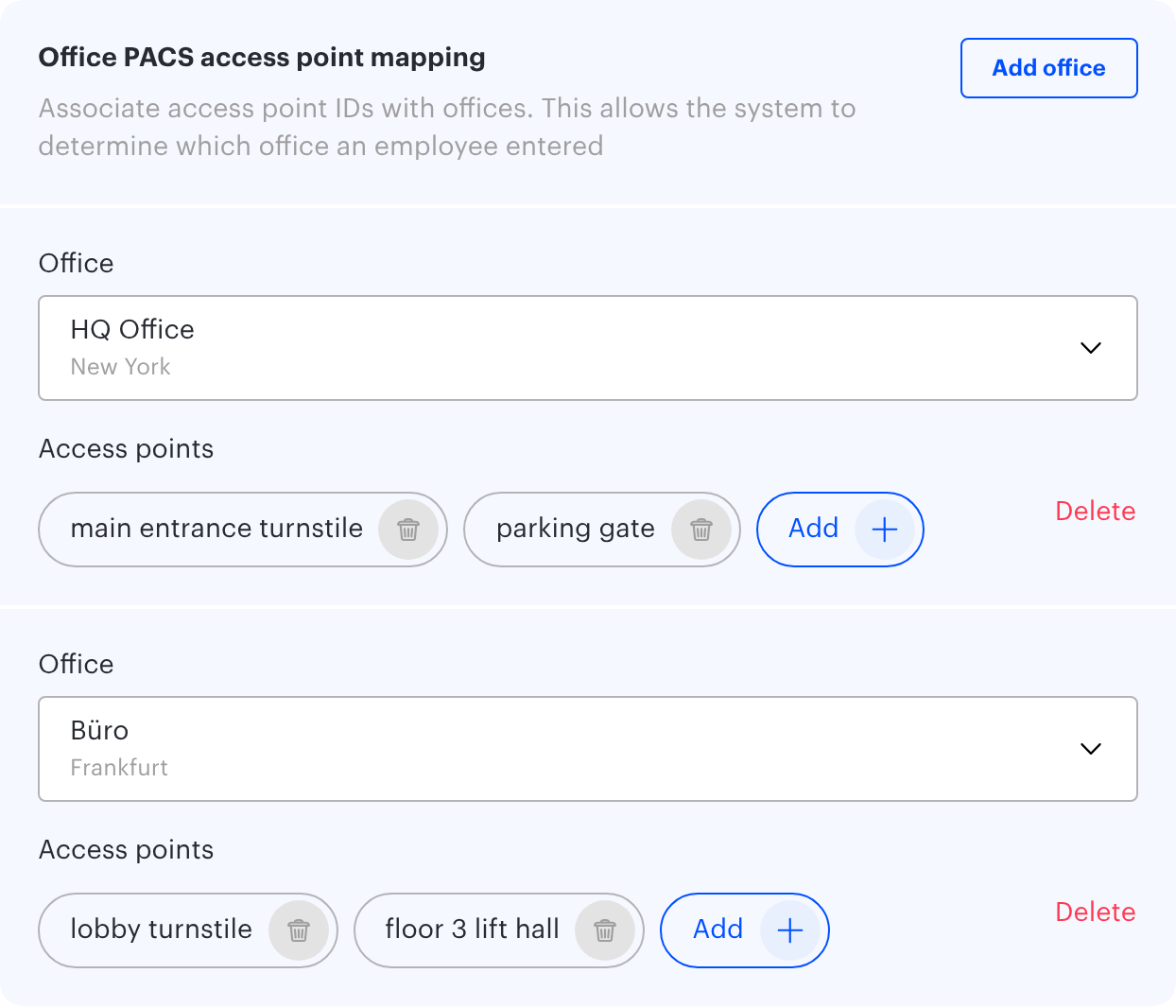
A webhook can map any number of offices, with up to one hundred access points each. The same access point cannot belong to two offices, so there is no ambiguity. If an event comes from an access point that is not on the list, it is still saved — just without an office.
Office analytics that is really about the office
The office filter in the By office and By desks analytics now applies not only to workplaces, but to the entries themselves. Select your Frankfurt office and you see entries to that office, not to every building the company has. With no office selected, the charts are built exactly as before.
When you load PACS data from a file (the Upload PACS data button in By office), the office is determined the same way: in the UnSpot format it comes from the office name column, in other supported formats — from the access point.
How to start
The mapping lives in Integrations → Incoming webhooks: open an existing webhook or create a new one, add offices with Add office and enter the access points exactly as your PACS names them. From then on, new events are linked to offices.
What you get
Analytics shows the real attendance of each site, not a company-wide picture. You can compare offices, see which one is underused and where desks run short, and make decisions on leases and seating based on actual numbers — even if a single PACS serves all your buildings.