
21-09-2026
Attendance rate control: the agreement you can finally see in numbers
A company moves to hybrid and agrees on three days a week in the office. Six months later, is the agreement working? Ask five managers and you will get five impressions. Ask someone to count it by hand and nobody will.
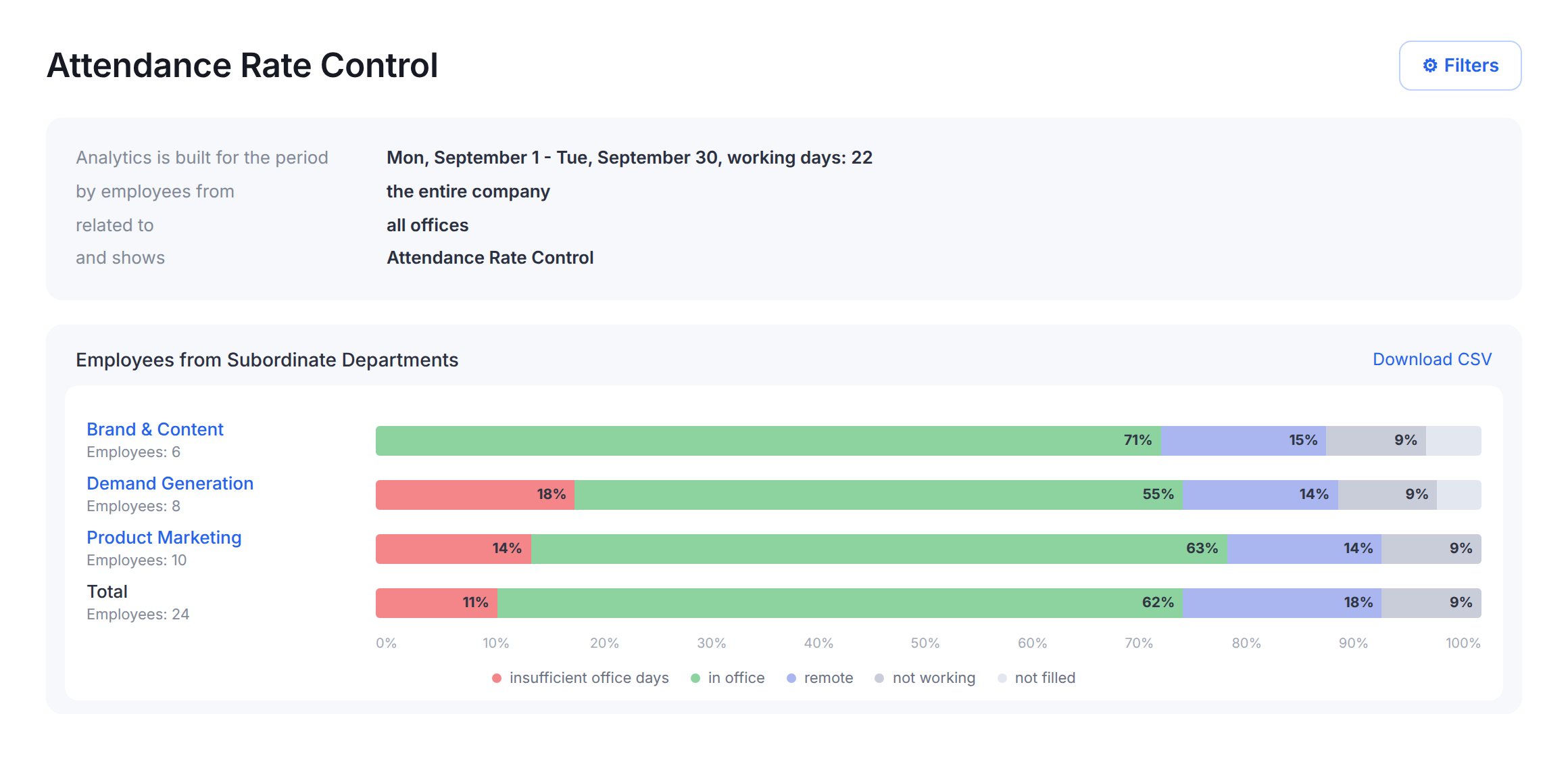
UnSpot analytics now has attendance rate control. It compares an employee's actual office visits with the rate set by their work mode and shows the difference — for the company, for a department and for a specific person.
Everyone has their own rate
The main thing to know about this mechanic: it does not measure everyone with the same ruler.
An employee who is fully remote or on a free schedule has no shortfall by definition — the system simply shows how their days were distributed. For a hybrid mode its own attendance percentage is used: if the rate is 80%, the comparison is against 80%, not against «the same as everyone else». For an office mode the rules are stricter: days marked as remote or left unfilled count towards the shortfall.
A holiday is not a debt
The rate is calculated not from every working day in a row, but from working days minus the ones when the person was not working. Two weeks of annual leave do not turn into a minus. Weekends and public holidays come from the production calendar and are not counted either.
It sounds like a detail at the level of a formula. In practice it is exactly why attendance reports are usually not trusted: show a person a «shortfall» that accumulated during their own holiday once, and the numbers lose all credibility.
What to do with it
The data is laid out at three levels: the company or a department as a whole, the individual employees of a department, and subordinate units. That gives three different conclusions:
- the shortfall is concentrated in one department — that is a targeted conversation with one manager, not a message to everyone;
- the shortfall is spread evenly across the company — then it is the rate that needs changing, not the people: it does not match how the company actually lives;
- the gap between the rate and the facts is stable — that is the honest answer to how much office the company really needs.
Hybrid work rests on agreements. An agreement nobody ever checks stops existing fairly quickly, and checking it by eye only damages relationships. It is better to have a number you do not want to argue with.